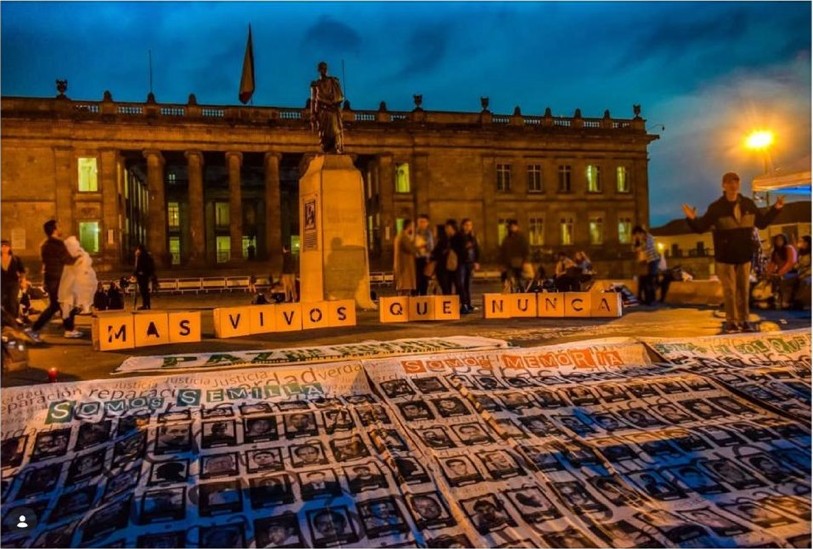
¡Más vivos que nunca! · Human rights memorial · Plaza de Bolívar, Bogotá
The research agenda
My research sits at the intersection of comparative politics, constitutional law, and the political sociology of law, and is animated by a decade of frontline practice at the core of Colombia's transitional justice process. I work with mixed methods — weaving together qualitative tools (participatory action research, archival analysis, discourse analysis, and ethnographic fieldwork) with quantitative and macro-historical comparison across cases.
How states and armed actors co-produce violence and criminal networks, and how accountability institutions can be designed to investigate and dismantle them. I develop the Systemic Research Approach (SRA), a judicial governance model that enables upward accountability against high-ranking commanders through integrated institutional design. Member of the Working Group on Criminal Politics (Northwestern · U of Chicago · UIC; Feldmann & Albarracín).
How courts, civil society organizations, and social movements contest the boundaries of rights and reshape democratic institutions. I pay particular attention to how Participatory Action Research transforms legal knowledge production inside constitutional and transitional justice settings, blurring the lines between academic, legal, and community-generated knowledge.
How legal mobilization across Latin America challenges prohibitionist regimes through constitutional and international human rights law, reframing drug use as a matter of public health and rights and opening space for harm-reduction and restorative approaches within criminal justice systems.
Works in progress
- Under review · Presented at MPSA 2026, Chicago The Systemic Research Approach: How Accountability Institutions’ Design Enables Investigating State-Criminal Networks
Abstract
Introduces the Systemic Research Approach (SRA): a model of judicial governance in which a single accountability institution develops five integrated capacities for reconstructing macro-criminal patterns rather than isolated acts. Using Colombia’s JEP as a paradigmatic case and five comparators — Guatemala’s CICIG, Cambodia’s ECCC, Sierra Leone’s SCSL, the ICC, and Argentina’s ESMA mega-cause — the article demonstrates that deliberate institutional integration produces structural documentation of state-criminal networks and an “accountability shock” that partial deployments cannot achieve.
- Working draft, April 2026 From Body Counts to State-Criminal Accountability: How Justice System Capacities Evolved to Prosecute Extrajudicial Killings in Colombia’s Catatumbo
Abstract
Argues that deterrence and accountability are analytically separable outcomes with different institutional preconditions. In the Catatumbo case, the violent practice of extrajudicial killings ceased in 2008 through administrative and political pressure; upward accountability — reaching brigade-level commanders — required the JEP’s integrated design combining investigative independence, cross-database articulation, conditional truth-telling incentives, subnational-national reach, and contextual analysis. Ordinary justice produced zero high-ranking convictions in a decade; the JEP achieved upward accountability in approximately four years.
- Working paper Beyond Judicial Truth: Civil Society Methodologies and the Transformation of Legal Knowledge in Colombia’s Transitional Justice
Abstract
Argues that human-rights organizations using Participatory Action Research (PAR) fundamentally transformed knowledge production within the JEP and the Truth Commission, subverting traditional boundaries between legal, academic, and social knowledge. Analysis of JEP’s Case 03 on extrajudicial executions shows how PAR methodologies were integrated directly into judicial resolutions and indictments, enabling victims to co-construct legal and historical truth and embedding Global South peacebuilding innovation into state-centric transitional justice.
Peer-reviewed articles
-
Abstract
Peer-reviewed analysis of the institutional and political disputes surrounding the protection of human rights defenders and social leaders in post-accord Colombia. Available in English and French. Situates Colombia's protection regime within broader debates on rights mobilization, state accountability, and the implementation of the 2016 Final Peace Agreement.
Book chapters
-
 From the Havana talks to the Colombian Congress: Where were the victims' rights in the legislative implementation of the Final Peace Agreement?
Abstract
Book chapter tracing how victims' rights were re-framed and contested during the legislative implementation of the 2016 Final Peace Agreement. Analyzes the gap between the victim-centered design agreed in Havana and the statutes later enacted by the Colombian Congress.
Policy & human rights reports
-
-
 Dismantling Paramilitarism: A proposal for public policy guidelines
 -
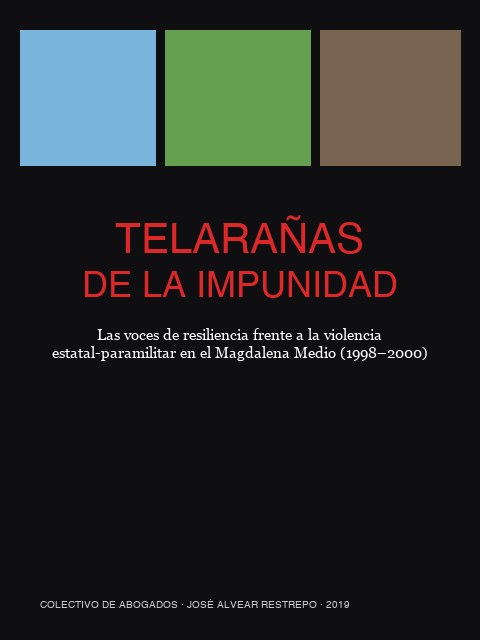 Web of Impunity: Voices of resilience against state and paramilitary violence in Magdalena Medio (1998–2000)
 -
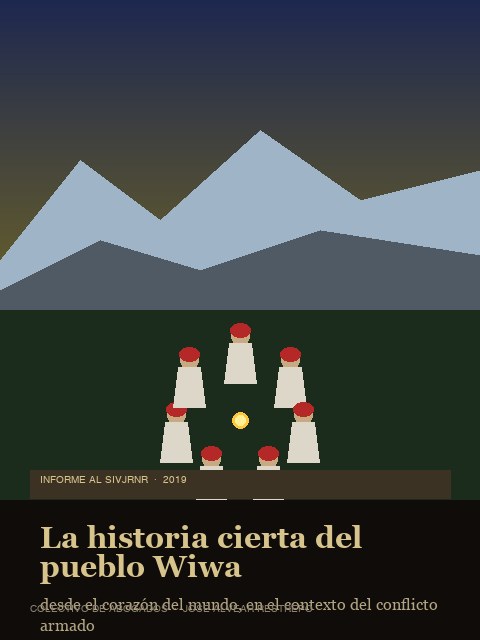 The true story of the Wiwa people — From the heart of the world — in the context of the internal armed conflict (1990–2017)
Research datasets
Empirical datasets compiled during a decade of strategic litigation and human-rights practice. Structured and documented for reuse in sociolegal research.
- Dataset Citizen Interventions before the Colombian Constitutional Court (2016–2020)
- Dataset Press Coverage of the Final Peace Agreement Implementation (2016–2019)
Amicus curiae briefs & constitutional court interventions
The 30+ amicus curiae briefs and constitutional interventions I submitted between 2017 and 2023 are documented separately on the Advocacy & Consulting page, where each entry links to the published Constitutional Court ruling where available.
Research experience
- June–Aug. 2025Research ConsultantProf. Yanilda González · Harvard Kennedy School, Harvard University
Specialized research on legal mechanisms for the investigation and sanctioning of aggressions and homicides committed by Colombia's fuerza pública. Mapped victims' and social-movement strategies for rights enforcement through legal and social channels. Consulting undertaken as part of Prof. González's forthcoming academic book on police accountability and state violence in Latin America.
- Aug–Oct 2017Research Fellow · Drug Policy and Transitional JusticeCIDE — Center for Research and Teaching in Economics, Aguascalientes, Mexico
Open Society Foundation Fellowship. Contributed to the Drug Policy Program's comparative study of transitional justice in Mexico and Colombia. Supervisor: Javier Treviño Rangel, Ph.D.
- 2016–2017Research Assistant · Office of the Academic Vice PresidentUniversidad de los Andes, Bogotá
Supported research coordination for a portfolio of peace-oriented studies responding to post-conflict educational needs in Colombia. Supervisor: Silvia Restrepo Restrepo, Ph.D.
- 2013–2014Research Assistant · Socio-Legal Research Center (CIJUS)School of Law, Universidad de los Andes
Contributed to The Enforcement of Tutela Rulings in Colombia (2012–2014), a joint project with Emory University and the World Bank — coded the complexity and clarity of court orders. Supervisor: Isabel Cristina Jaramillo, Ph.D.